From 1960 to 1972, Chevrolet pickup trucks underwent an evolutionary shift. They transformed from spartan, utilitarian farm tools into comfortable, stylish, daily-driver family vehicles. This era is broadly split into two legendary design generations: the rugged “Task Force” successor / First-Gen C/K (1960–1966) and the iconic, smooth-riding “Action Line” (1967–1972).
Whether you are scouring a swap meet, validating a potential purchase, or ordering restoration parts, this year-by-year technical breakdown will help you spot the exact model year of any 1960–1972 Chevy truck at a glance.
Decoding the Nomenclature: What is a C10?
Before diving into the design aesthetics, it helps to decode the model naming convention introduced by General Motors in 1960:
C (Conventional): Two-wheel drive (2WD)
K: Four-wheel drive (4WD)
10: 1/2-Ton payload capacity (Light Duty)
20: 3/4-Ton payload capacity (Heavy Duty)
30: 1-Ton payload capacity (Heavy Duty)
Example: A K20 is a 4×4, 3/4-ton truck, while a C10 is a 2WD, 1/2-ton truck.
Generation 1: The 1960–1966 C/K Series
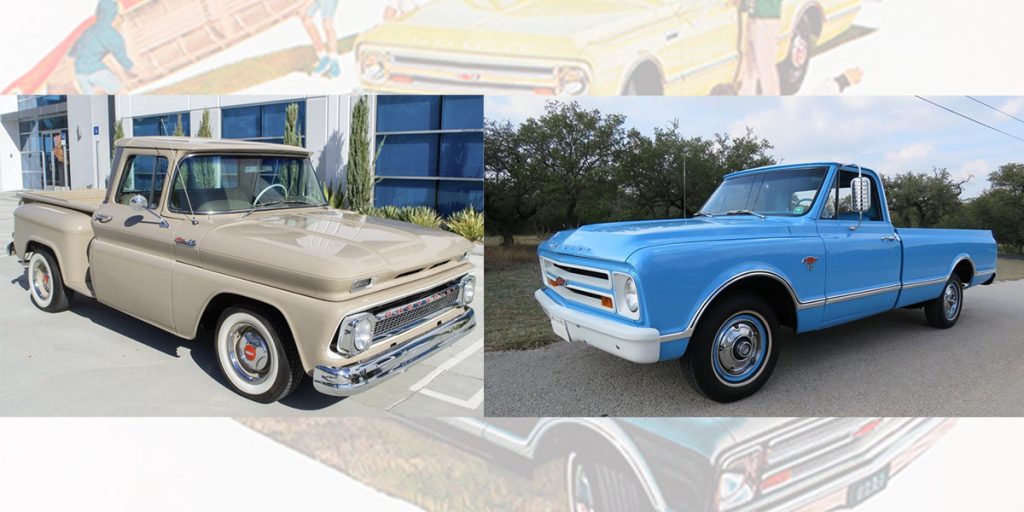
Compared to the later 1967-1972 years, this generation is easy to spot with its aggressively sculpted hoods, panoramic cabs, and deep-set body lines.
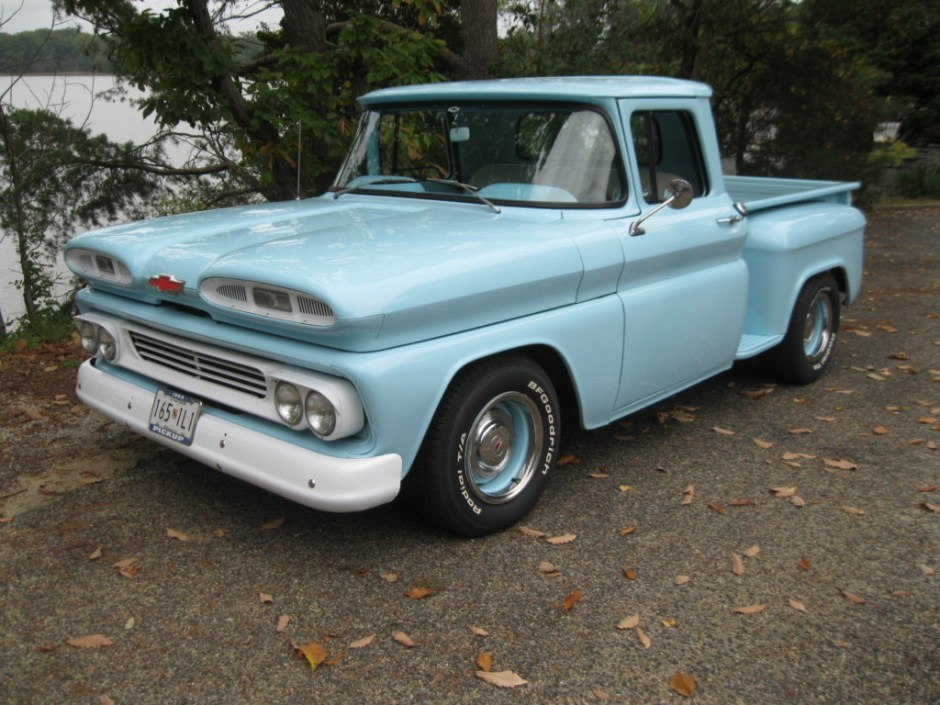
1960
-
The Front Facade: Features a low-mounted grille with dual headlights on each side (four total). The word “CHEVROLET” is prominently embossed across the lower grille bar.
-
The Hood: Known as the “Jet Pod” hood. It features two large, oval “nostril” openings at the front. The turn signals/parking lamps are integrated into these pods behind vertically louvered bezels.
-
The Cab: Uses a radical forward-sloping windshield pillar (A-pillar), creating a wrap-around, panoramic windshield design.
-
Badging: Front fenders feature “CHEVROLET” on top, with the word “APACHE” and the numeric series designation underneath.
1961
The Front Facade: Very similar to 1960 with dual headlights, but the lower bar of the grille is now smooth. The center oval section houses four vertical louvers alongside the “CHEVROLET” lettering.
The Hood: Retains the oval “nostril” pods, but the parking lamps inside them transition to a distinct “winged” or finned lens design.
Badging: The “CHEVROLET” script is removed from the fender emblem; it now only reads “APACHE” alongside the series number (10, 20, or 30).
1962
-
The Front Facade: Swaps out the quad setup for single headlights wrapped in massive, ribbed bezels. The center grille layout shifts to a crosshatch pattern, forming 9 rectangular openings.
-
The Hood: The oval nostril pods are completely gone. A new, flatter hood features a continuous, crisp character line running around the front and down the body side.
-
Badging: Side emblems feature a prominent red Bowtie overlaid on a vertically ribbed background with the series number.
1963
The Front Facade: The single headlights feature much smaller, simpler round trim rings. The grille pattern switches to an intricate egg-crate design with 56 individual rectangular openings (3 horizontal bars intersecting 13 vertical bars).
Mechanical Note: This is a crucial transition year underneath the sheet metal. The front suspension moves to variable-rate coil springs, and the clutch shifts from hydraulic to mechanical linkage.
Badging: The fender emblem becomes a vertical rectangle with the series number on top and a red Bowtie on the bottom.
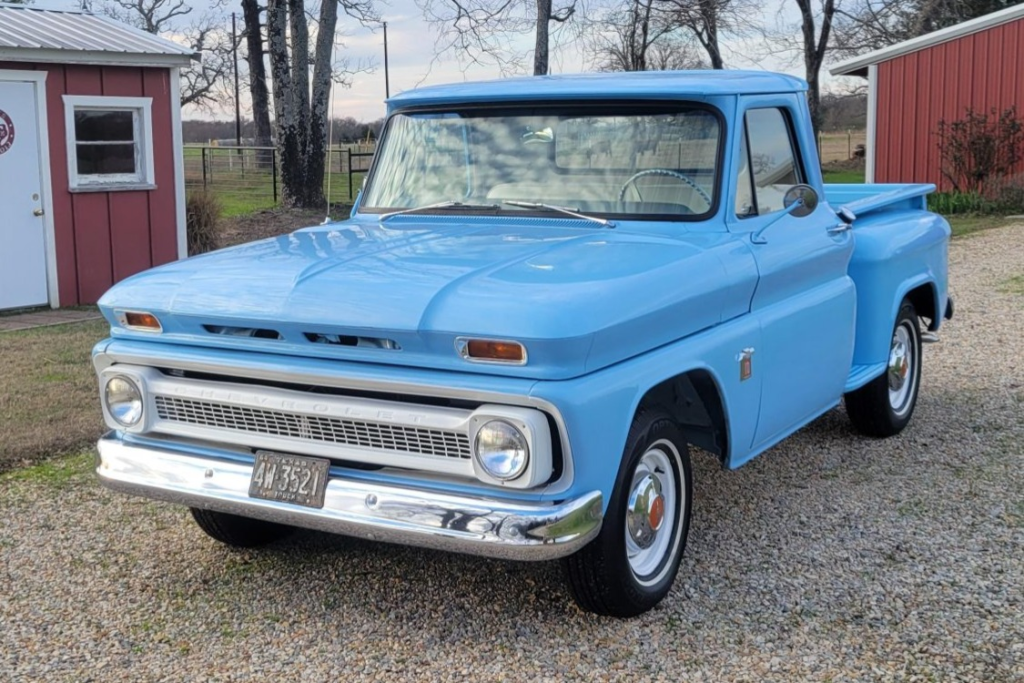
1964
The Cab Transformation: A major engineering milestone. The wrap-around windshield and forward-sloping A-pillars are eliminated. The windshield becomes flatter, the pillar posts slope backward, and the door glass area becomes significantly larger.
The Front Facade: Features a fine-mesh, screened grille look with numerous tiny crosshatches. The single headlights are housed in distinct rectangular outer bezels.
Badging: Emblems are squarish with the series designation embossed next to a small Bowtie.
1965
The Front Facade: Virtually identical to the 1964 grille and cab structure.
Badging: The main identifying marker for a ’65 is the side badging. The emblem becomes a horizontal rectangle split cleanly into two halves: a red Bowtie occupies the left side, and the series designation fills the right side.
1966
The Front Facade: The final year of the first-generation body style. The sheet metal remains unchanged from 1965.
Badging: The horizontal rectangular fender emblem is flipped vertically. It now places the Bowtie squarely on top and the series designation (10, 20, 30) below it.
Mechanical Note: This was the first year the legendary 327 cu in V8 engine and the Turbo-Hydramatic automatic transmission became factory options.
Generation 2: The 1967–1972 "Action Line"
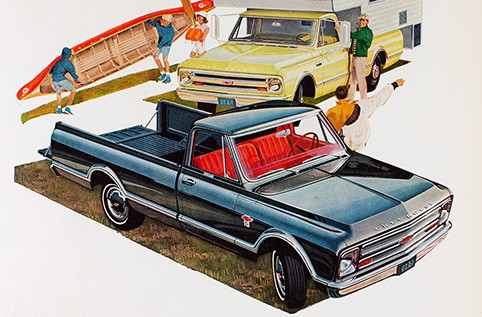
Referred to by gearheads as the Glamour Pickups, this generation lowered the cab profile, flattened the body panels, and introduced car-like interior amenities. It’s the most popular out of the classic C10s, but that’s purely a matter of opinion.
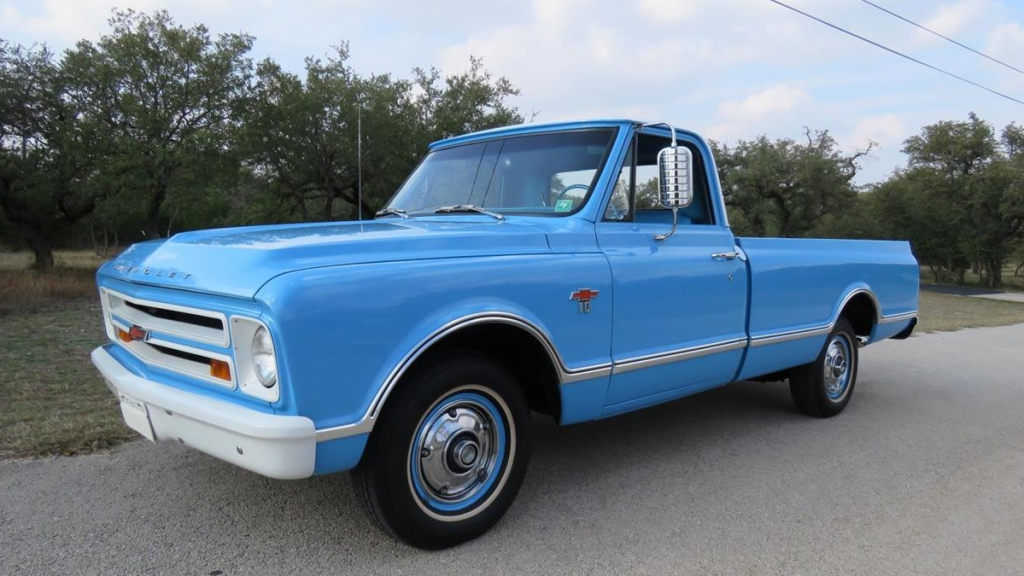
1967
The Body: A completely clean-sheet redesign. The cab is lower, more aerodynamic, and features crisp, flat body sides.
The Profile: No side marker lights. This is the definitive way to spot a 1967 model at a glance.
The Rear Glass: A small rear window was standard equipment, while the panoramic “big back window” was an optional upgrade.
The Front Facade: A stark, two-opening grille layout with a minimalist center horizontal bar and a central Bowtie emblem. The word “CHEVROLET” is spelled out across the leading edge of the hood.
1968
The Profile: Side marker lights make their debut on the lower corners of the front fenders and rear bedsides to comply with new federal safety mandates.
The Rear Glass: The small rear window is completely discontinued; all cabs now feature the large rear glass window.
The Front Facade: The grille profile remains similar to ’67, but Custom Sport Truck (CST) trim packages add bright anodized aluminum trim that wraps around the entire grille and headlight assemblies.
1969
-
The Front Facade: A drastic facelift year. The grille becomes a massive, one-piece anodized aluminum assembly. A thick center bar spans the full width, splitting the egg-crate insert and wrapping entirely around the headlights. The word “CHEVROLET” is written directly across this center grille bar, and the turn signals move inside the grille.
-
The Hood: Because the lettering moved to the grille, the Bowtie emblem was moved up onto the front slope of the hood.
-
Interior: This is the first year of the foot-operated parking brake (replacing the old hand-pull lever under the dash).
1970
The Front Facade: Visually very close to the 1969 layout, but with a distinct plastic insert change. The 1970 grille insert features 12 distinct clusters of short horizontal fins—six stacks sitting above the center bar and six sitting below it.
Badging: Fender emblems now read “CST/10”, “Custom/10”, etc., with independent engine displacement callouts (like “350” or “400”) mounted directly underneath.
1971
The Front Facade: The grille is overhauled again. It features a bold, bright aluminum border surrounding a dark, tight “egg-crate” rectangular plastic mesh insert. The Bowtie emblem moves back to the absolute center of the grille.
The Bumper: The parking lamps/turn signals are moved out of the grille and integrated directly into the front bumper.
Mechanical Note: Front wheel disc brakes become standard factory equipment for the first time across the light-duty line.
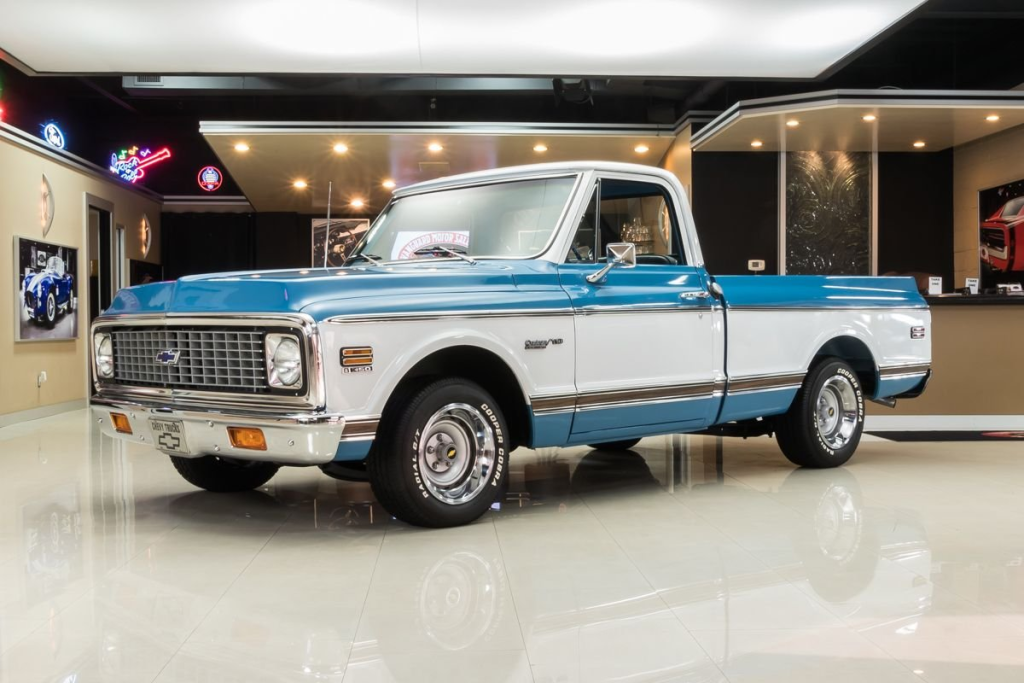
1972
The Front Facade: Structurally identical to the 1971 grille layout, but with one subtle, definitive styling change: the metal trim boundary surrounding the center Bowtie emblem is removed.
The Rearview Mirror: Look through the windshield. If the rearview mirror is glued directly to the glass, it’s a 1972. If the mirror bracket is screwed into the cab sheet metal above the windshield, it’s a 1971 or older.
Trim Packages: The ultra-luxurious “Cheyenne” and “Cheyenne Super” packages peak this year, featuring heavy woodgrain exterior side molding, carpeted lower door panels, and plush vinyl seating.
C10 Quick Reference Identification Table
| Year | Headlights | Turn Signal Location | Side Marker Lamps? | Tailgate/Hood Lettering |
| 1960 | Quad (4) | Hood Pods (Nostrils) | No | “CHEVROLET” on lower grille bar |
| 1961 | Quad (4) | Hood Pods (Winged) | No | “CHEVROLET” inside grille center |
| 1962 | Single (2) | Hood Corner Bezels | No | “CHEVROLET” embossed on grille |
| 1963 | Single (2) | Grille Outer Corners | No | 56-hole egg-crate grille mesh |
| 1964 | Single (2) | Grille Outer Corners | No | Flat windshield, sloping-back A-pillars |
| 1965 | Single (2) | Grille Outer Corners | No | Horizontal split fender emblem |
| 1966 | Single (2) | Grille Outer Corners | No | Vertical stacked fender emblem |
| 1967 | Single (2) | Lower Grille Opening | No | Letters on front edge of hood |
| 1968 | Single (2) | Lower Grille Opening | Yes | Big rear window becomes standard |
| 1969 | Single (2) | Inner Grille Bars | Yes | Letters on center bar of grille |
| 1970 | Single (2) | Inner Grille Bars | Yes | Fin-style grille inserts (6 over 6) |
| 1971 | Single (2) | Front Bumper | Yes | Bowtie emblem in center of mesh grille |
| 1972 | Single (2) | Front Bumper | Yes | Rearview mirror glued to windshield glass |
If you need any help figuring out what year your C10 is, or need parts for your C10, hop on SS396.com or give our friendly techs a call at (203) 235-1200!